
GD350A
INVT / General-purpose VFDs
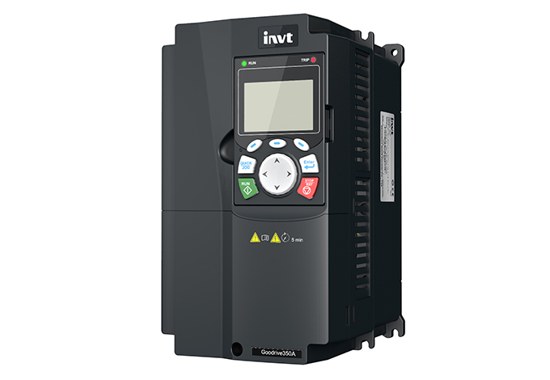 Manufacturer product reference
INVT GD350A
INVT GD350A dual-rated 380 V vector drives from 1.5 to 500 kW. Choose the order code by constant- or variable-torque current, expansion-slot count and braking configuration.
Choosing a GD350A order code
Every standard GD350A code carries two ratings. GD350A-004G/5R5P-4, for example, is a 4 kW, 9.5 A constant-torque drive or a 5.5 kW, 12.5 A variable-torque drive, depending on how it is applied. Size the code from the motor current and the load: constant-torque loads such as conveyors and mixers need the G rating with its 150% one-minute overload, while fans and centrifugal pumps can use the P rating at 120%. Then check the frame details that change the quotation: drives of 5.5 kW and below accept two expansion cards, 7.5 kW and above accept three, and braking hardware is built in, optional or external depending on size. The figures here come from INVT’s GD350A manual V1.3; INVT’s product page quotes faster control figures than this manual, so confirm which document applies to the delivered firmware.
- Manual scope
- GD350A Series VFD Manual V1.3: three-phase 380 V (−15%) to 440 V (+10%), 47–63 Hz; GD350A-1R5G/2R2P-4 to GD350A-500G-4. GD350A-HR and GD350A-S book-type units have separate INVT documents
- Dual rating
- G = constant torque, P = variable torque in one code; constant-torque output current 3.7 A (1.5 kW) to 860 A (500 kW) at 380 V output; GD350A-500G-4 has no P rating
- Overload
- 150% for 1 minute (G); 120% for 1 minute (P)
- Control and motors
- V/F, sensorless vector (SVC) and closed-loop vector with encoder (FVC); asynchronous and permanent-magnet synchronous motors. INVT’s product page adds synchronous-reluctance support through customized software
- Manual control limits
- Speed ratio 1:200 SVC (asynchronous), 1:20 SVC (synchronous), 1:1000 FVC; torque response <20 ms SVC, <10 ms FVC; 0–400 Hz output
- Expansion slots
- Two cards at 5.5 kW and below, three at 7.5 kW and above (SLOT1–SLOT3); encoder (PG), I/O, programmable, communication, IoT and 24 V supply cards are bought separately
- Communication cards
- Manual V1.3 card table: PROFIBUS-DP (EC-TX503), CANopen via the CAN card (EC-TX505C), PROFINET (EC-TX509), EtherNet/IP (EC-TX510), Modbus TCP (EC-TX515), INVT Ethernet (EC-TX504), Bluetooth and Wi-Fi. EtherCAT is listed on the product page and in parameter options but not in this table
- Braking and DC reactor
- Braking unit built in up to 037G/045P; optional for 045G/055P–055G/075P (order suffix -B); external braking units from 075G/090P. DC reactor built in for 018G/022P–110G/132P; external reactor connection from 132G/160P
- Standard I/O
- 2 analog inputs (AI1 0–10 V/0–20 mA, AI2 −10 to 10 V), 1 analog output, 4 digital inputs plus 2 high-speed 50 kHz inputs, 1 high-speed pulse output, 1 open-collector output, 2 relays
- Environment and EMC
- IP20, forced air; −10 to +50 °C with derating above 40 °C; derate 1% per 100 m above 1000 m. IEC/EN 61800-3 C3 as supplied, C2 with an optional external filter
- Safe Torque Off
- Built-in STO; INVT’s product page states SIL2, and manual Appendix E gives the STO logic, channel delay and installation checklist
Questions for this product range
- Quote the full code (for example GD350A-030G/037P-4) and state whether the G or P rating is applied to this motor and load.
- For 045G/055P–055G/075P, is the -B built-in braking unit included, or is an external braking unit quoted?
- List each expansion card part number and its slot, and confirm the frame has enough slots for encoder, fieldbus and I/O together. For EtherCAT, name the card part number.
- Which document and firmware govern control performance? The product page and manual V1.3 give different torque-response and speed-ratio figures.
- For a synchronous-reluctance motor, which customized software version is supplied and how is it supported?
- Which ambient and altitude derating has been applied to the quoted output current?
Source documents
Source notes checked 2026-10-24. See the linked manufacturer documents for model and option details.