

Shenzhen Dolycon Technology Co., Ltd.
Dolycon is a Shenzhen manufacturer established in 2015. Alongside general CT-series drives, it develops dedicated controls for machines and solar pumping. Its published application material shows three different jobs: veneer feed calculation within CT210, compressor logic within DL1000, and photovoltaic power tracking within CT112S.
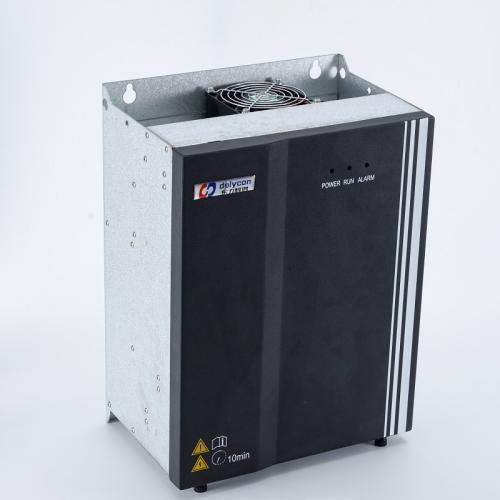
The Shenzhen company behind the CT product families.
The English brand can be traced to a specific Chinese enterprise and operating address.
Established in 2015
Dolycon’s current introduction dates the company to 2015 and identifies Shenzhen as its headquarters. The October 2020 V1.1 selection catalogue prints Shenzhen Dolycon Technology Co., Ltd. alongside 深圳市东力科创技术有限公司. A Shenzhen government list for the 2020 high-tech enterprise recognition subsidy names the Chinese company at entry 598. That public record supplies a historical identity cross-check; the catalogue is also useful for distinguishing this brand from similarly named suppliers.[1][2][3]
Guangming operating location
The current website publishes the second floor, B area of Building A1, Tieta Industrial Park, Hedi Road No. 10, Gongming, Guangming district. Its company page presents industrial dedicated VFD research and manufacturing as the principal business. The product navigation combines general CT drives with dedicated machinery and solar-pump families, so the company’s scope extends beyond a single standard motor-speed controller.[1]
Control algorithms, hardware design and load testing.
Dolycon describes a development and manufacturing operation intended to support dedicated machine requirements.
Custom development around the working condition
The corporate introduction describes an independent development cycle covering control algorithms, hardware and product testing. It identifies an R&D and technical-service team and offers customised development for working conditions that standard products do not fit. The CT210 and DL1000 examples below make that approach concrete: each combines drive hardware with control functions belonging to a particular machine.[1][5][6]
The published production checks
Dolycon states that its manufacturing checks include incoming-material inspection, process control and full-load burn-in of units. These are the manufacturer’s descriptions of its own operation. For a supplied drive, the useful follow-through is a model-specific inspection record and an agreed load-test scope tied to the delivered hardware and firmware. For a dedicated controller, include the machine’s actual signals and operating sequence in that scope.[1]
CT500 provides a general-drive route with configurable interfaces.
Its book-style housing and expansion choices address control-cabinet and motor-feedback requirements.
Choose the control hardware as well as the power
The CT500 page describes synchronous and asynchronous motor support, open- and closed-loop capabilities and encoder expansion. Its options list includes differential and UVW differential PG cards, plus Profibus-DP, PROFINET, CANopen, DeviceNet and Modbus TCP communication cards. Standard RS485 is described as Modbus RTU. The selected feedback or network module therefore belongs in the actual configuration, rather than being inferred from the CT500 family name.[4]
Braking changes with the selected size
For three-phase 380 V models, the product table lists CT500-4T-7.5G-B at 18.5 A output. The braking note says models up to 160 kW can have an internal braking unit, with that unit optional over the 37–160 kW range; at 185 kW and above it is external. A rapid-stop machine enquiry should identify the fitted braking unit and resistor specification alongside the motor current and stopping duty.[4]
CT210 keeps the rotary-cutting calculation inside the drive.
The October 2022 application explains the controls, feedback signals and calibration of a spindleless veneer-peeling machine.
Touchscreen, CT210 and CT110 have separate jobs
Dolycon places the rotary-cutting control logic in CT210, developed on the CT200 platform. The touchscreen supplies the operator display, while CT110 is used for the cutting knife. The article contrasts this with an arrangement where an external text controller calculates frequency and sends it over a communication link. Moving the calculation into the drive changes where the machine’s feed-control decisions are made.[5]
Displacement becomes feed speed
The described system obtains tool-post displacement from screw-motor encoder pulses, calculates the remaining log diameter and uses a mathematical model to determine feed speed. HDI1 and HDI2 receive the encoder’s A/B pulses. A drive output triggers the cutter controller as the required veneer length is reached. Those details connect the control package to the machine’s rollers, screw mechanism and cutting cycle.[5]
Mechanical data belongs in the commissioning brief
The article separates motor identification, factory mechanism settings and user production settings. Mechanism data includes roller diameter and speed, centre distance, screw pitch and transmission ratio; user settings cover veneer thickness, cut length, core size and opening position. It then discusses wood learning and tail-piece calibration. For a replacement or new machine, provide those mechanical values and the encoder details so the supplier can configure the actual mechanism.[5]
DL1000 combines the drive with air-compressor control logic.
The December 2025 application note describes signal and actuator integration, rather than a generic energy-saving claim.
Machine signals and auxiliaries
Dolycon describes DL1000 inputs for pressure, temperature, emergency-stop and fault signals, together with control of 220 V solenoid valves. It also identifies a 24 V supply for the touchscreen and a Modbus interface. The company’s dedicated compressor touchscreen completes the described package, allowing its compressor control logic to operate without a separate external controller or PLC in that arrangement.[6]
Define what the integrated controller must handle
An enquiry for this package should identify the compressor motor, pressure and temperature sensor types, valve loads and operator-screen requirements. The complete machine still needs its own protective and emergency-stop design. The application note establishes the intended controller functions; the supplier’s wiring and system proposal should show which functions and auxiliaries are included in the delivered DL1000 configuration.[6]
CT112S has two electrical sides: the PV array and the pump motor.
The product table keeps array-input limits separate from motor-output ratings.
Swipe horizontally to compare all columns.
| CT112S model | Rated power | Maximum DC input current | Rated motor output current |
|---|---|---|---|
| CT112S-4T-5.5G-B | 5.5 kW | 23 A | 14 A |
| CT112S-4T-7.5G-B | 7.5 kW | 35 A | 18.5 A |
Power tracking with water-related operation
CT112S converts photovoltaic DC to AC for the pump and varies output frequency as sunlight changes through maximum-power-point tracking. Its feature list includes water-level sleep/wake, sunlight-related sleep/wake, dry-pumping protection, RS485 and a GPRS remote-control route. The page also describes AC input availability. Confirm the AC/DC supply arrangement and remote-control hardware for the selected model when backup power is required.[7]
Two concrete model examples
For the 380 V three-phase output route, the page recommends an MPPT working range of 540–630 V DC and gives 780 V DC as maximum PV open-circuit input. The two model examples show that PV input current and motor output current are separate ratings. The string design must also account for module open-circuit voltage at the site’s temperature extremes; the recommended MPPT range is not an open-circuit limit.[7]
Site and water requirements
The CT112S technical page specifies forced-air cooling and protection from direct sunlight, dust, corrosive gas, dripping water and salinity. It calls for derated operation between 40 and 50 °C and above 1000 m. Provide the array/string data, pump head and flow, motor nameplate, water-level signals and installation conditions together. That lets the supplier match an electrical model to the actual pumping system.[7]
Explore Dolycon products on VFDMatch.
Continue with the published series or exact model before preparing your request.
CT112S-4T-2.2G-B
Solar pump inverter with published DC open-circuit input range of 300–780 V and three-phase 380 V output. DC input limits are not AC supply ratings. Check cold-weather array open-circuit voltage, MPPT operating range and pump motor compatibility.
CT112S-4T-4.0G-B
Solar pump inverter with published DC open-circuit input range of 300–780 V and three-phase 380 V output. DC input limits are not AC supply ratings. Check cold-weather array open-circuit voltage, MPPT operating range and pump motor compatibility.
CT112S-4T-5.5G-B
Solar pump inverter with published DC open-circuit input range of 300–780 V and three-phase 380 V output. DC input limits are not AC supply ratings. Check cold-weather array open-circuit voltage, MPPT operating range and pump motor compatibility.
A brief that makes the next reply useful.
Copy these prompts and add your project details. Keep the same scope when comparing quotations.
- CT500, dedicated machine control or CT112S solar pumping
- Full drive model and motor nameplate
- For veneer: mechanism values and encoder signals
- For compressors: sensors, valve loads and touchscreen
- For solar pumping: PV strings, pump duty and water signals
- Cooling, installation and acceptance-test scope
Buyer questions
Where is Dolycon’s operating address?
The current website lists Building A1, Tieta Industrial Park, Gongming, Guangming district, Shenzhen.
Does CT210 rely on the touchscreen to calculate feed speed?
The published application places the rotary-cutting logic in CT210 and uses the touchscreen for the operator display. Encoder-derived displacement is used for log-diameter and feed calculations.
Are PROFINET and encoder feedback standard on every CT500?
The page lists communication and PG expansion cards as options. Identify the actual fitted modules in the offered configuration.
Is CT112S’s MPPT voltage range its maximum array voltage?
No. For the reviewed 4T route, the page gives 540–630 V DC as the recommended MPPT range and 780 V DC as maximum PV open-circuit input.
Sources & editorial review
Company and product facts are drawn from the sources below. The project briefs and procurement notes are VFDMatch editorial analysis. Statutory disclosures establish company records; order-specific technical acceptance uses the applicable product documents.
- Official company page
Dolycon current company introduction
2015 origin, current premises, R&D and manufacturing/testing approach
Reviewed 2026-10-08 - Manufacturer catalogue archived by a training platform
CT-series selection catalogue, October 2020 V1.1
Cover connects the English company name and Chinese legal identity; historical edition
Reviewed 2026-10-08 - Government publication
Shenzhen 2020 high-tech enterprise subsidy candidate list
Page 12, entry 598 names 深圳市东力科创技术有限公司; historical record
Reviewed 2026-10-08 - Manufacturer technical page
CT500 book-style general-purpose drive
Encoder/communication options, model data and braking-unit note
Reviewed 2026-10-08 - Manufacturer application explanation, 13 October 2022
CT210 rotary-cutting machine application
CT210/CT110/touchscreen roles, displacement feedback and machine calibration
Reviewed 2026-10-08 - Manufacturer application note, 31 December 2025
DL1000 integrated air-compressor control
Pressure/temperature/fault inputs, valve control and touchscreen integration
Reviewed 2026-10-08 - Manufacturer product specifications
CT112S solar-pump technical page
PV voltage/input current, motor output, water/sunlight control and environmental requirements
Reviewed 2026-10-08
Ready to define the configuration?
Bring your motor nameplate, load cycle and controller details to the next discussion.