
Shenzhen Inovance Technology Co., Ltd.
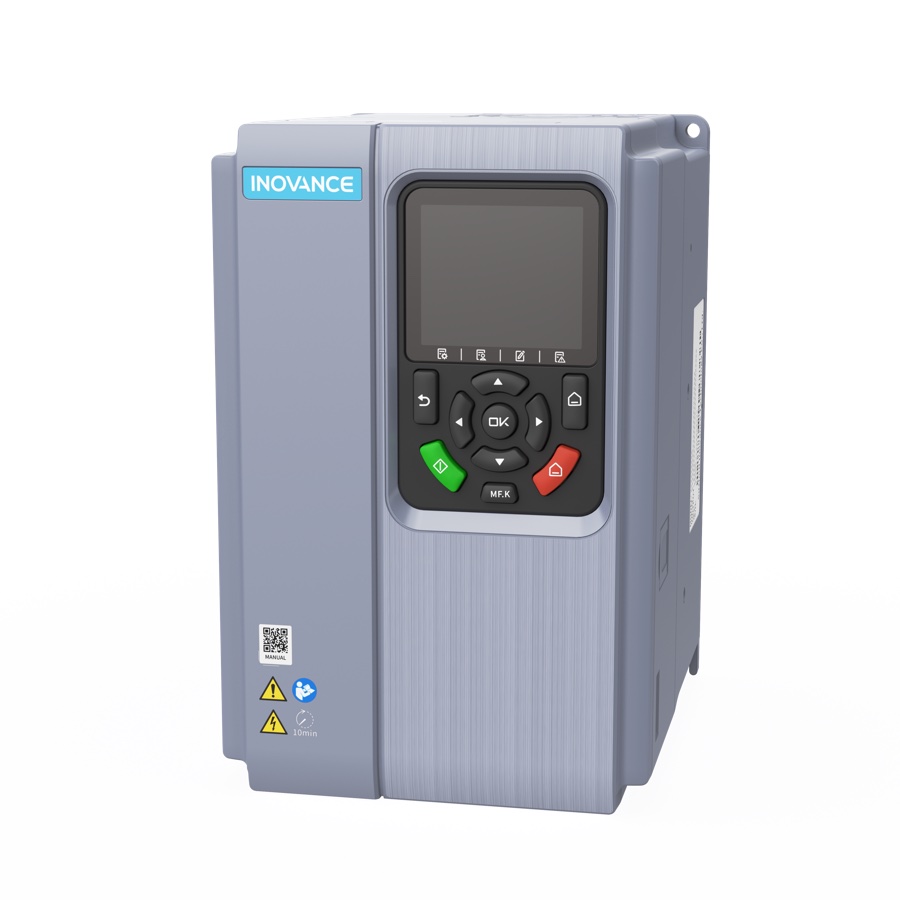
Inovance’s industrial-automation business spans AC drives, servos, motors and controllers. Its MD520 illustrates how those products meet a real machine: a Spanish motor manufacturer uses two drives in a test bench, one controlling the test motor and the other its load. This profile connects that installation with the company’s manufacturing history, duty-specific electrical ratings and published development and support processes.
- Company established
- 2003[1]
- Production milestone
- Suzhou base operating since 2011[1]
- Documented installation
- VASCAT · two 220 kW MD520 drives[5]
An automation company with several distinct businesses.
The industrial motor-drive offer sits within a broader group, rather than representing every Inovance activity.
From motor drives to machine systems
Founded in 2003, Inovance records its Shenzhen GEM listing in September 2010 under stock code 300124. Its present corporate overview separates industrial automation and digitalization from new-energy-vehicle powertrains, intelligent robotics and digital energy. For a machine builder, the relevant industrial catalogue connects motor drives with servo axes, programmable control and operator interfaces. A vehicle powertrain or energy-storage project follows a different product and engineering route.[1][4]
A catalogue whose boundaries matter
The European library lists MD200, MD290, MD500 and MD520 independently of MD800, MD810 and MD880. Servo entries include IS620, SV660 and SV670, alongside motor and controller documents. This is useful when defining supply scope: an MD520 quotation for one motor does not by itself specify the PLC, servo axes or a multidrive system. The manufacturer’s 2018 acquisition of Germany’s PA also belongs to its machine-tool development history, rather than being evidence that all these products share one architecture.[1][4]
Production development, with the dates kept intact.
The official timeline distinguishes a base entering operation from a construction project.
- 2011
Suzhou base enters operation
The company records an operating base, alongside the acquisition of Changchun Weton for transducer technology and product platforms.[1]
- 2014
Automated production line
An automated line enters operation, providing a specific manufacturing milestone in the company’s history.[1]
- 2017
Intelligent-manufacturing centre construction
The Suzhou project is described as construction; this date is not relabelled as the opening of a completed facility.[1]
- 2022
Additional bases begin operating
Yueyang, Changzhou and Nanjing are recorded as entering operation. The Hungary base is separately described as beginning construction.[1]
What the history establishes
These milestones show how Inovance has extended its production footprint and introduced manufacturing automation. They do not allocate every current drive model to a particular factory. An order requiring a specific manufacturing location should therefore identify that site in the supplier’s offer and shipping documentation. The published history supports the development narrative; model-specific origin and delivery commitments belong to the individual order.[1]
MD520: motor control with identifiable options.
Control modes, feedback and accessories need to match the machine, not merely its nominal motor power.
Motor and application functions
The global product page and V0.4 brochure describe control of asynchronous, permanent-magnet synchronous and synchronous-reluctance motors. The brochure distinguishes open-loop V/F for induction motors, sensorless vector control and closed-loop flux-vector control. Named machine functions include tension, brake and position control; the global page lists textile, paper, wire drawing, machine tools, packaging, food, fans and pumps. These are family capabilities. Selection still depends on the actual motor and operating mode.[2][3]
Read the order code and the option list together
Printed page 3 of V0.4 explains voltage prefixes, braking-unit and STO suffixes, reactor variants and the INT international version. The communication list on page 2 includes EtherNet/IP, PROFINET and EtherCAT among the available options. The same page states that operation above 40°C involves derating, although ambient operation is listed up to 50°C. A quotation should consequently identify fitted network and feedback hardware, the safety version and the thermal selection basis alongside its full drive code.[3]
The same frame has different heavy- and normal-duty ratings.
Two examples from the three-phase 380–480 V table make the distinction visible. These are V0.4 brochure ratings, not measured results.
Swipe horizontally to compare all columns.
| Model column in V0.4 | Heavy duty | Normal duty |
|---|---|---|
| MD520-4T75 · applicable suffixes per order | 75 kW / 150 A | 90 kW / 176 A |
| MD520-4T220 · S / -L variants in table | 220 kW / 426 A | 250 kW / 520 A |
| Published overload capacity | 150% for 60 s | 110% for 60 s |
Keep the current and carrier-frequency footnote
Printed pages 4–5 specify rated output current at the default carrier frequency. In the 75 kW and 220 kW heavy-duty columns used here, that default is 3 kHz. The normal-duty values are separate entries, rather than an extra current allowance to add to the heavy-duty rating. For a high-temperature cabinet or a machine needing another switching frequency, engineering selection must use the relevant derating instructions instead of reusing these table currents unchanged.[3]
Cable length changes the configuration question
The V0.4 table footnote recommends motor cable below 100 m for the standard drive and describes an -L version with an AC output reactor for longer runs. It also directs application-specific cable-length discussion to the regional representative. Cable length, motor insulation requirements and the proposed reactor therefore belong in the electrical brief, especially when replacing a drive on an existing machine whose motor is some distance from the cabinet.[3]
A motor manufacturer’s test bench: two drives, two roles.
Inovance’s 21 April 2026 case describes VASCAT in Spain. The named equipment makes this more useful than a generic application list.
Test motor and controlled load
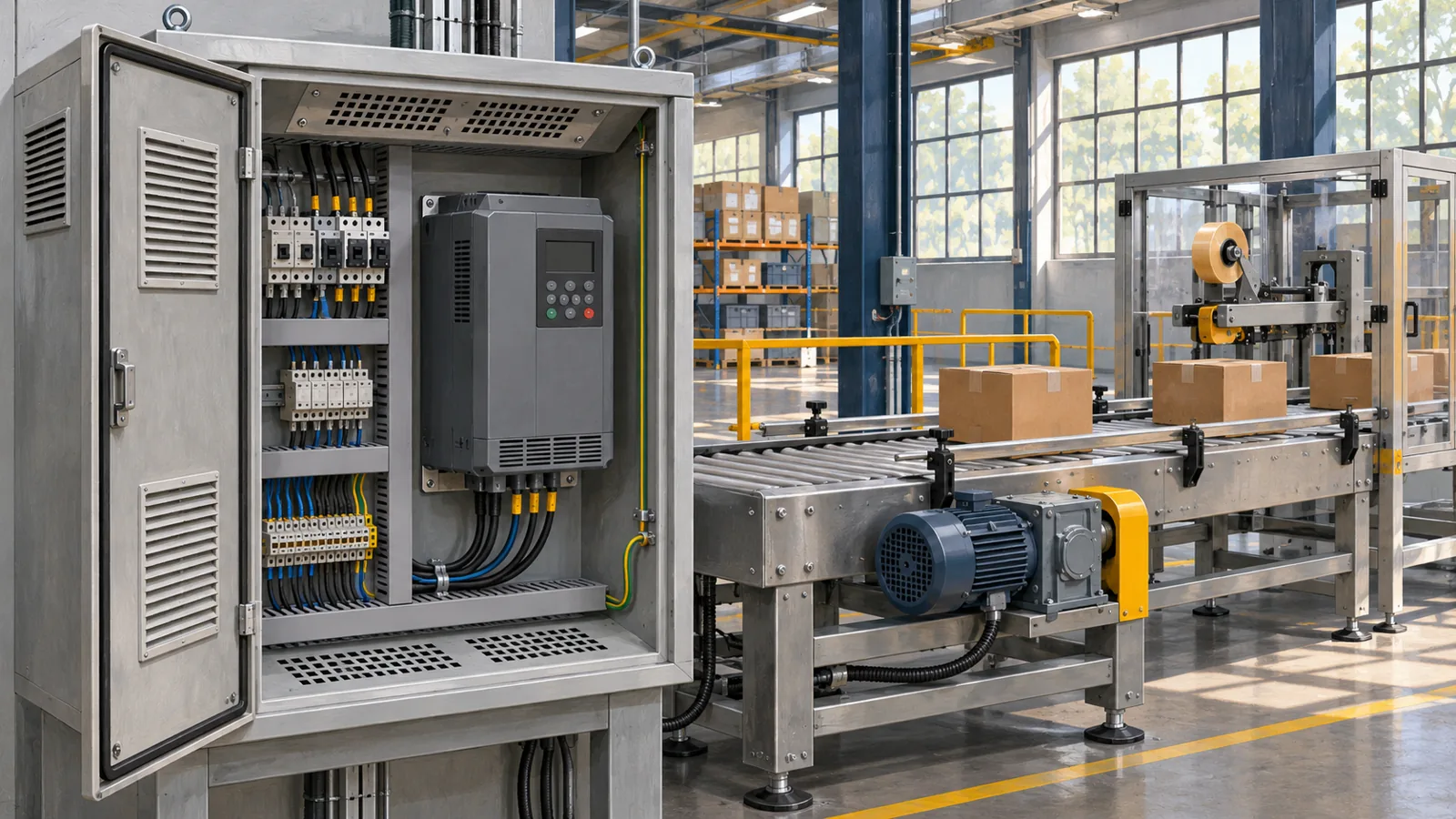
The installation uses two 220 kW MD520-4T220S-INT drives. One operates the motor being tested; the other controls a second motor acting as the load. VASCAT’s work includes induction, synchronous-reluctance and permanent-magnet synchronous motors, with and without feedback. According to the case, preliminary feedback-free tests help isolate feedback-related problems before closed-loop testing. This is a manufacturer-published account of the installation, not a test conducted by VFDMatch.[5]
Integration into an existing bench
The reported bench retained a common DC bus and a third-party master using EtherNet/IP. Its accessory list identifies MD500-EN1 network cards, MD38PGMD incremental-encoder cards and SOP-20-810 LCD keypads. Commissioning required adaptation to the replacement drives’ parameters. That detail is central to a retrofit brief: compatibility involves the installed interface cards, feedback signals, supervisory control and parameter mapping, rather than just matching the old and new power labels.[5]
IPD develops the product; ITR closes the customer issue.
Inovance publishes two named business processes with different purposes. This is a description of those processes, not an audit certificate.
IPD: requirements before product development
The quality-culture page describes Integrated Product Development as a path from market requirements through development and innovation to product launch. It names requirement management, charter development and product/solution development. For a machine builder proposing an unusual duty, the useful input is a defined requirement: motor behaviour, operating cycle, environment and controller interfaces. This gives a technical discussion a clear starting point instead of relying on a broad claim that a drive is suitable for an industry.[6]
ITR: a resolution and a broader closure
Issue to Resolution addresses customer response, solutions and prevention. The published explanation distinguishes resolving the customer’s issue from closing similar issues more broadly. In a practical handover, the machine team can retain the fault record, corrective action and configuration revision so that a later recurrence can be traced. The process description does not establish a guaranteed response time or a measured defect rate; those commitments require an order-specific service agreement.[6]
Explore Inovance products on VFDMatch.
Continue with the published series or exact model before preparing your request.
A brief that makes the next reply useful.
Copy these prompts and add your project details. Keep the same scope when comparing quotations.
- Motor type, nameplate current and test/load or production-machine role
- Full MD520 order code, selected duty and required overload cycle
- Supply voltage, carrier frequency, cabinet temperature and motor cable length
- Controller/master, fitted communication-card code and parameter mapping
- Encoder type, feedback-card code, braking/reactor and safety configuration
- Commissioning acceptance, parameter backup and support/corrective-action records
Buyer questions
What exactly was supplied for the VASCAT motor-test bench?
The published case names two MD520-4T220S-INT drives, MD500-EN1 EtherNet/IP cards, MD38PGMD incremental-encoder cards and SOP-20-810 LCD keypads. One drive controls the test motor and the other its load.
Why does a 75 kW MD520 column also show 90 kW?
The V0.4 380–480 V table gives that model column 75 kW / 150 A in heavy duty and 90 kW / 176 A in normal duty, with different overload ratings. Selection must retain the duty and applicable configuration.
Can the published table current be used unchanged at 50°C?
The V0.4 brochure states derating above 40°C. Its output-current table also carries a default-carrier-frequency footnote. Use the applicable installation and derating instructions for the selected unit.
What is the difference between IPD and ITR?
Inovance describes IPD as requirements and product development through launch. ITR concerns customer-issue resolution and prevention, including closure of similar issues beyond the immediate case.
Sources & editorial review
Company and product facts are drawn from the sources below. The project briefs and procurement notes are VFDMatch editorial analysis. Statutory disclosures establish company records; order-specific technical acceptance uses the applicable product documents.
- Official company history
Inovance corporate history and milestones
Foundation, listing, operating production bases and dated construction milestones; read 2026-10-08.
Reviewed 2026-10-08 - Official product page
MD520 global product overview
Motor-control scope and machine functions. Family features are distinct from an individual ordered configuration.
Reviewed 2026-10-08 - Manufacturer technical brochure
MD520 English brochure · V0.4
Printed pages 2–5: functions, ordering code and 380–480 V heavy/normal-duty tables. Output currents are specified at default carrier frequency.
Reviewed 2026-10-08 - Official engineering library
European product and document library
Separate AC-drive, multidrive, servo, controller and motor document entries; MD520 V0.4 brochure link.
Reviewed 2026-10-08 - Manufacturer-published customer case
VASCAT electrical-motor testing installation
Published 2026-04-21: test/load motors, common DC bus, third-party EtherNet/IP control and named drive/accessory codes. Performance statements are the supplier’s report.
Reviewed 2026-10-08 - Official quality-process description
Inovance quality culture: IPD and ITR
Requirements and product development; issue response, resolution and prevention of similar issues. No independent audit conclusion is inferred.
Reviewed 2026-10-08 - Statutory disclosure
2024 annual report summary
Printed pages 1–2: Shenzhen reporting entity, securities code 300124 and general-automation products. Historical 2024 business segmentation is distinct from the current corporate overview.
Reviewed 2026-10-08
Ready to define the configuration?
Bring your motor nameplate, load cycle and controller details to the next discussion.