

V&T Technologies Co., Ltd.
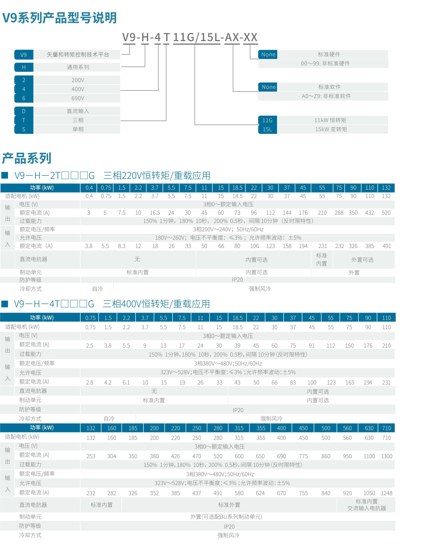
V&T is the English brand of 深圳市蓝海华腾技术股份有限公司, a Shenzhen power-electronics company established in 2006 and listed in 2016 under code 300484. Its industrial inverters sit alongside servo, elevator and vehicle-control products. The V9-H-6T manual provides a particularly concrete view of its industrial offering: model-specific input and output currents, timed overload with recovery conditions, feedback control choices and frame-dependent braking hardware.
- Company established
- 2006 · Shenzhen[1]
- Development locations
- Xiamen industrial park · Wuxi R&D[1]
- Technical reference
- V9-H-6T · three-phase 660/690 V[3]
- 690 V installation
- IP20 · forced-air cooling[3]
Industrial drives and vehicle controls developed along separate routes
The company’s own chronology places product platforms alongside the development of its industrial and research locations.
- 2006–2009
Vector-drive origins and vehicle entry
The corporate history records company formation and product-platform work in 2006, a vector/torque-control inverter release in 2007 and entry into the new-energy vehicle sector in 2008–2009.[1]
- 2016–2018
Listing and operating locations
V&T records its 2016 Shenzhen Growth Enterprise Market listing. Its2017–2018milestones identify the Xiamen industrial park and Wuxi research centre entering use.[1]
- 2019–2024
Single drives, multidrives and controls
The chronology names V9-H and AIEC elevator products in 2019, VTS800 and DTS800 multidrive development in 2021–2022, and later PLC/HMI, VTS30 and BU braking-unit releases.[1]
The entity behind the English brand
The Chinese company page identifies 深圳市蓝海华腾技术股份有限公司, while the English catalogue uses V&T Technologies Co., Ltd. and the same securities code 300484. The current company contact address is in Shenzhen’s Guangming district. This connects the brand to the enterprise without substituting an older catalogue address for the present contact location.[1][2]
The industrial drive, vehicle controller and compressor are different products
V&T’s corporate scope is broader than a general-purpose inverter supplier. Each equipment enquiry still needs its own engineering boundary.
Power electronics and machine platforms
The company describes research, manufacturing, sales and service for inverters, servos, electric-vehicle motor controllers, DC/DC products and elevator drive/control systems. Its later multidrive and PLC/HMI releases add system-level options. A coordinated industrial-drive proposal should identify the common-DC and controller arrangement rather than treating several individual inverter ratings as a complete architecture.[1]
A separately identified mechanical-equipment subsidiary
The official Lanhai Precision page identifies a subsidiary in Shenzhen Guangming engaged in oil-free scroll-compressor development, production, sales and service. That compressor business is distinct from selecting a VFD for a customer’s compressor motor. The national standards platform also names the parent company among the drafters of the die-casting machine energy-efficiency project that led to GB/T 39962-2021, providing a separate institutional company reference.[5][4]
Input current and motor-output current are separate columns
Printed page 2 of the V9-H-6T manual identifies a constant-torque/heavy-duty 690 V route. These selected entries preserve both electrical sides of the drive.
Swipe horizontally to compare all columns.
| Heavy-duty model | Motor power | Rated output current | Rated input current |
|---|---|---|---|
| V9-H-6T75G | 75 kW | 86 A | 85 A |
| V9-H-6T110G | 110 kW | 120 A | 116 A |
| V9-H-6T710G | 710 kW | 770 A | 750 A |
Supply and voltage tolerance
The model table specifies three-phase 660/690 V at 50/60 Hz, an allowable 587–793 V range and a voltage-unbalance limit of 3%. It lists IP20 protection and forced-air cooling. These figures belong to this 690 V manual scope; the broader V9 family description also covers other voltages, which should retain their own model documents.[3]
Keep the motor and supply checks distinct
Motor continuous current is compared with the drive’s output rating. The input column serves a different part of the electrical design and is not a substitute for the motor-output value. Preserve the complete model, motor nameplate and supply details when comparing a quotation to the manual table.[3]
Timed overload needs recovery, while closed-loop operation needs feedback
The manual describes both the thermal-duty envelope and different motor-control arrangements.
Three overload levels with an interval
The 690 V table gives 150% for one minute, 180% for ten seconds and 200% for half a second, with a ten-minute interval and inverse-time characteristic. For repetitive acceleration or process peaks, the peak magnitude, duration and recovery belong together. A single percentage cannot describe the complete repeat duty.[3]
Open-loop and closed-loop functions differ
Printed page 3 separates synchronous/asynchronous open-loop and closed-loop control. Position control is identified in the closed-loop column and absent from the open-loop column; the manual also gives different speed-range and regulation values for those modes. A position-control or low-speed axis enquiry should therefore identify the encoder and fitted feedback interface rather than relying on the generic vector-control label.[3]
An optional brake unit changes the model and terminal arrangement
Printed page 17 distinguishes base models, the -06 option and larger frames. This matters when a replacement must retain its stopping behaviour or DC connections.
Swipe horizontally to compare all columns.
| Manual variant | Published braking arrangement | Configuration implication |
|---|---|---|
| 15G–90G base models | No built-in braking unit | Identify the external braking hardware where needed |
| 15G–90G with -06 | Optional built-in braking unit | Different braking-resistor terminal arrangement |
| 110G and above | No built-in braking unit | Specify external braking hardware and frame wiring |
| 280G-GS and larger cabinet models | No DC-bus wiring terminals in the shown standard arrangement | DC connection requires a specifically agreed configuration |
Braking duty is part of resistor selection
Printed page 8 relates resistor and unit selection to system inertia, deceleration time, lowering duty and frequency of braking. Its reference calculation assumes a stated braking duty, with a note that the listed resistor powers are based on braking periods within 30 seconds. A frequent or long-duration stopping cycle needs its own calculation rather than adopting a table entry without the operating conditions.[3]
Common DC is not a blanket terminal assumption
The manual describes common-DC capability, but the terminal section explicitly distinguishes cabinet GS models and option arrangements. It also requires coordination with the manufacturer when combining DC-reactor and braking functions in the relevant built-in-brake version. Retain the full suffix and an agreed circuit drawing in the proposal, especially for a retrofit into an existing cabinet.[3]
The installed current rating depends on temperature, elevation and the cable route
The manual’s environmental and accessory conditions complete the drive selection after the model-current table.
Temperature and elevation derating
Printed page 3 specifies operation at −10 to +40 °C, with derating between 40 and 50 °C at 1% of rated output current per additional degree. Above 1,000 m it specifies 1% per 100 m within its 0–2,000 m elevation range. It calls for vertical installation in a ventilated electrical cabinet and non-condensing conditions. These limits should be applied to the cabinet’s actual operating environment.[3]
Input and output reactor choices
The 690 V manual identifies input/output reactors as optional and recommends an input reactor for power above 110 kW and an output reactor when the motor cable exceeds 50 m. Its printed page 15 provides model-specific reactor current and inductance references. Include cable length, existing cabinet hardware and the proposed reactor arrangement with the electrical brief.[3]
Control and service information
The manual lists an RS485 Modbus RTU interface and several command sources, including terminals, keypad, analogue input and process PID. For an existing machine, collect its active command route, feedback card, full drive nameplate, stopping cycle and applicable manual before agreeing the replacement. This keeps the quotation tied to the real installation rather than a generic product-family claim.[3]
Explore V&T products on VFDMatch.
Continue with the published series or exact model before preparing your request.
A brief that makes the next reply useful.
Copy these prompts and add your project details. Keep the same scope when comparing quotations.
- Full V9-H-6T model, suffix and motor nameplate
- Actual 660/690 V supply and continuous motor current
- Peak duration, repetition and recovery interval
- Encoder, fitted feedback card and command route
- Braking hardware and DC/reactor circuit drawing
- Cabinet temperature, elevation and motor-cable length
Buyer questions
Which company operates the V&T brand?
The Chinese company site identifies 深圳市蓝海华腾技术股份有限公司. Its English catalogue uses V&T Technologies Co., Ltd. and securities code 300484.
Does every V9-H-6T drive contain a braking unit?
The reviewed manual distinguishes 15G–90G base models from the -06 built-in-brake option, and identifies external braking for 110G and larger frames. Keep the complete model and terminal drawing.
What recovery condition accompanies the 690 V overload ratings?
The table states 150% for one minute, 180% for ten seconds and 200% for half a second, with a ten-minute interval and inverse-time characteristic.
Can the 690 V current table be used without environmental checks?
The manual also specifies temperature and elevation derating, IP20 vertical cabinet installation and reactor recommendations. Those conditions belong with the model rating.
Sources & editorial review
Company and product facts are drawn from the sources below. The project briefs and procurement notes are VFDMatch editorial analysis. Statutory disclosures establish company records; order-specific technical acceptance uses the applicable product documents.
- Official company history
V&T Chinese corporate introduction and history
Chinese entity,2006origin,2016listing,Xiamen/Wuxi milestones and industrial/vehicle portfolio
Reviewed 2026-10-08 - Manufacturer catalogue
V&T inverter product catalogue — English VX-20230612-H-4.0
Complete8-page scan; cover and introduction spreads visually read for English identity and company/product context
Reviewed 2026-10-08 - Manufacturer technical manual
V9-H-6T Series 690 V technical manual
Complete204-page PDF; printed2/3ratings and environment,printed8braking duty,printed15reactors,printed17terminal variants
Reviewed 2026-10-08 - National standards authority
SAMR die-casting machine energy-efficiency standard project
Drafting participant in plan20181936-T-604,linked to publishedGB/T39962-2021; not drive certification
Reviewed 2026-10-08 - Official subsidiary presentation
V&T subsidiary — Lanhai Precision
Shenzhen Guangming subsidiary and separate oil-free scroll-compressor business
Reviewed 2026-10-08
Ready to define the configuration?
Bring your motor nameplate, load cycle and controller details to the next discussion.