

Shenzhen MICNO Electric Co., Ltd.
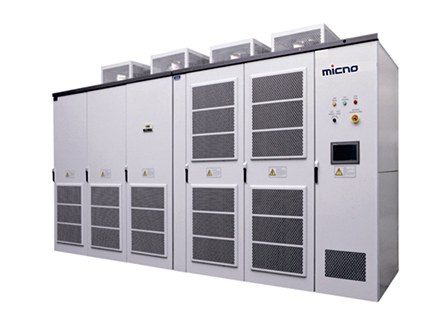
MICNO develops electrical drives in Shenzhen’s Guangming district. Its industrial and solar-drive portfolio includes HE1000 medium-voltage cabinet systems. Two published fan retrofits reveal what that business involves: transformers and power cells, duty/standby motors, bypass switchgear and the interface to an operating plant.
- Established
- 31 January 2012[1]
- Company record
- NEEQ stock code 839477[1]
- Published project
- 1600 kW blast-furnace blower, 10 kV[7]
A drive company established in Guangming, Shenzhen.
MICNO’s corporate history and its published company charter identify the business behind the brand.
- 2012
Company established
The English corporate history gives 31 January 2012 as the establishment date.[1]
- 2015
Shareholding reform
MICNO records its conversion to a joint-stock company on 20 July 2015.[1]
- 2016
Industrial-park move and NEEQ listing
The history records a Guangming industrial-park move in April and NEEQ listing on 10 November, under stock code 839477.[1]
The legal and operating identity
The September 2026 charter names 深圳市迈凯诺电气股份有限公司 and gives floors 4 and 5 of Building 1, Invengo RFID Industrial Park, Tongguan Road, Guangming district as its registered premises. The English website’s contact address lists the fourth floor of the same park. The charter’s licensed business scope includes development, production and sale of frequency converters and industrial-automation equipment. This is a company-authored disclosure, available through Eastmoney’s financial-document archive.[1][3]
Motor control and power electronics sit at the centre of development.
The company describes both the disciplines behind its products and the way it manages development and manufacturing.
An IPD development approach
MICNO’s Chinese overview identifies motor control, power electronics, photovoltaic generation and industrial communication as its core technologies. It describes integrated product development, or IPD, supported by experimental and testing equipment. That combination helps explain the breadth of the catalogue: a low-voltage machine drive, a solar-pump inverter and a medium-voltage cabinet system address different engineering tasks within electrical conversion and motor control.[2]
Production-stage quality control
The factory overview describes monitoring through production stages, multiple quality-control checks and professional training before personnel take up laboratory or production work. It also identifies cleanliness as a manufacturing concern. The published description establishes the company’s stated quality approach; it does not name individual test stations or give a model-specific acceptance procedure. For an HE1000 order, the cabinet inspection and factory acceptance documents belong with the agreed system configuration.[4]
HE1000 combines a transformer, power cells and plant controls.
The system is selected around a medium-voltage motor and its electrical room, rather than around a wall-mounted enclosure alone.
Integrated or separate cabinets
The selection guide illustrates an integrated arrangement for lower capacities and separate transformer, unit/control and bypass cabinets for higher capacities. Its listed voltage classes include 3, 3.3, 4.16, 6, 6.6, 10 and 11 kV. These drawings make the installation scope tangible: cabinet footprint, access, cooling and the bypass connection all accompany the electrical rating. Dimensions in the model tables are reference values, so the selected equipment’s general-arrangement drawing should define the final footprint.[6]
Control and motor variants
The current product page describes series-connected power cells and a DSP, ARM and FPGA control platform. It distinguishes V/F control for fans, pumps and compressors from open-loop vector applications such as conveyors and mills, and feedback-vector duties such as hoists. It also describes asynchronous and synchronous motor support. Four-quadrant regeneration is a separately described system route; a buyer should identify that variant explicitly when the process requires returned energy.[5]
Lianyungang Beigang Nickel: a 1600 kW blower retrofit.
MICNO’s December 2021 report names the plant and connects the drive selection to an existing blast-furnace air system.
From starting equipment and dampers to variable speed
The report describes a 10 kV, 1600 kW motor and an original arrangement using a water-resistance starter and damper adjustment. Its equipment table identifies HE1000-1600G-T16, a 112 A current value and a one-drive/two-fan manual-bypass arrangement. The motor power is a useful project reference, while the switchgear and bypass are part of the retrofit scope. The report dates from 2021; it describes that installation rather than a current standard package for every 1600 kW fan.[7]
Information available to the plant
MICNO describes module-temperature and bus-voltage monitoring, fault records and status transfer to a DCS through RS485 or hardwired signals. This is particularly relevant to a process blower: the plant needs to see operating and fault states as well as send a speed command. A new proposal can use that interface discussion to define the required points list and the division of responsibility between the drive supplier and the plant-control contractor.[7]
Four drives serving an eight-fan extraction system.
The aluminium application has a different duty pattern and a clearly stated standby arrangement.
One online fan and one spare per drive
The 9 December 2021 article describes an unnamed Shandong aluminium plant’s second electrolysis workshop. Eight 10 kV asynchronous motors are listed at 900 kW and 65 A each, with four fans normally operating and four held in reserve. MICNO identifies four HE1000-0900G-T16 drives. The report expressly states that each one-drive/two-fan arrangement operates one fan through the inverter while the other is a backup; it is not simultaneous two-motor operation from one drive.[8]
A remote operator box, rather than the blower’s DCS description
The published scheme uses a remote control box to start and stop the drive and adjust frequency. Output current, output frequency and ready/running/fault indications are returned to the monitoring room. The operator adjusts speed for the required extraction flow and pressure. These details distinguish this installation from the Beigang blower account and provide a concrete example of a retrofit that retained much of the original control system.[8]
Power-cell bypass and mains bypass solve different problems.
Both appear in HE1000 documentation, but they belong to different parts of the system.
Inside the inverter: power-cell bypass
The current HE1000 overview describes bypass of a failed power cell, including same-level and neutral-point-shift methods. The selection guide discusses adaptive output after cells are bypassed. The engineering question is the available motor voltage and process duty in the remaining configuration, together with the permitted bypass arrangement for the selected cabinet.[5][6]
Outside the inverter: power-frequency bypass
The selection guide’s printed pages 21/22 show manual and automatic one-drive/one-motor and one-drive/two-motor switchgear arrangements. These provide a path associated with mains-frequency operation and motor changeover. They are distinct from bypassing an individual power cell. For a plant retrofit, the supplier’s system drawing should show motor selection, interlocking, command authority and how bypass states are reported to plant controls.[6][8]
The offered cabinet’s revision matters as much as its family name.
MICNO’s current web overview and downloadable selection catalogue describe different specification sets.
Keep ratings attached to their document
The selection catalogue’s printed pages 03/04 give IP31, 0 to +40 °C ambient operation and overload references of 120% for one minute and 150% for two seconds. The current online technical table instead lists IP30, −5 to +40 °C, 120% for two minutes and 150% for five seconds. The downloadable guide does not state a revision date. These figures should remain attached to their respective sources until MICNO identifies the document and ratings applicable to the actual offer.[5][6]
Bring the electrical room and process into the enquiry
For HE1000, provide the motor nameplate, supply voltage and plant single-line diagram alongside the fan or other process duty. Specify the cooling arrangement, available cabinet space, requested bypass and DCS or remote-box signals. Request the matching rating sheet, general-arrangement drawing and acceptance-test scope. That gives the supplier enough information to propose a cabinet system while keeping the operational boundaries visible to the plant team.[6][7][8]
Explore MICNO products on VFDMatch.
Continue with the published series or exact model before preparing your request.
A brief that makes the next reply useful.
Copy these prompts and add your project details. Keep the same scope when comparing quotations.
- Motor nameplate and process duty
- Medium-voltage supply and single-line diagram
- Cabinet room, cooling and available space
- Power-cell and mains-bypass requirements
- DCS or remote-box signal list
- Offered revision and factory acceptance scope
Buyer questions
Is MICNO based in Shenzhen?
Yes. The corporate history and September 2026 charter identify premises in Guangming district, Shenzhen, including the Invengo RFID Industrial Park address.
Does one HE1000 drive run two aluminium-plant fans simultaneously?
In the published Shandong application, no. Each drive serves a pair with one fan online through the inverter and the other held as a backup.
Are power-cell bypass and mains bypass the same feature?
No. Power-cell bypass acts within the inverter. Power-frequency bypass and changeover use the plant’s cabinet and switchgear arrangement.
Which HE1000 overload rating should an enquiry use?
Use the rating sheet and revision for the offered cabinet. The current online technical table and undated downloadable selection catalogue publish different overload durations and environmental ratings.
Sources & editorial review
Company and product facts are drawn from the sources below. The project briefs and procurement notes are VFDMatch editorial analysis. Statutory disclosures establish company records; order-specific technical acceptance uses the applicable product documents.
- Official corporate history
MICNO company history
Establishment, 2015 reform and 2016 NEEQ listing
Reviewed 2026-10-08 - Official company overview
MICNO Chinese company profile
Development disciplines, IPD and laboratory resources
Reviewed 2026-10-08 - Company disclosure hosted by Eastmoney
MICNO September 2026 company charter
Articles 3, 4 and 15: Chinese legal name, registered address and production scope
Reviewed 2026-10-08 - Official manufacturing overview
MICNO factory overview
Production-stage quality monitoring and personnel training
Reviewed 2026-10-08 - Manufacturer product page
HE1000 current product overview
Second-generation controls, motor types and power-cell bypass
Reviewed 2026-10-08 - Manufacturer technical catalogue; revision not stated
HE1000 selection guide
Printed pages 03/04, 05/06 and 21/22: cabinets, specifications and bypass arrangements
Reviewed 2026-10-08 - Manufacturer project report, 2 December 2021
Lianyungang Beigang Nickel blast-furnace blower application
1600 kW / 10 kV motor, HE1000 selection and DCS monitoring
Reviewed 2026-10-08 - Manufacturer application report, 9 December 2021
Shandong aluminium-plant flue-gas purification application
Four drives, eight 900 kW motors and one-duty/one-standby operation
Reviewed 2026-10-08
Ready to define the configuration?
Bring your motor nameplate, load cycle and controller details to the next discussion.